Ductless vs Central AC Florida: A Complete Guide
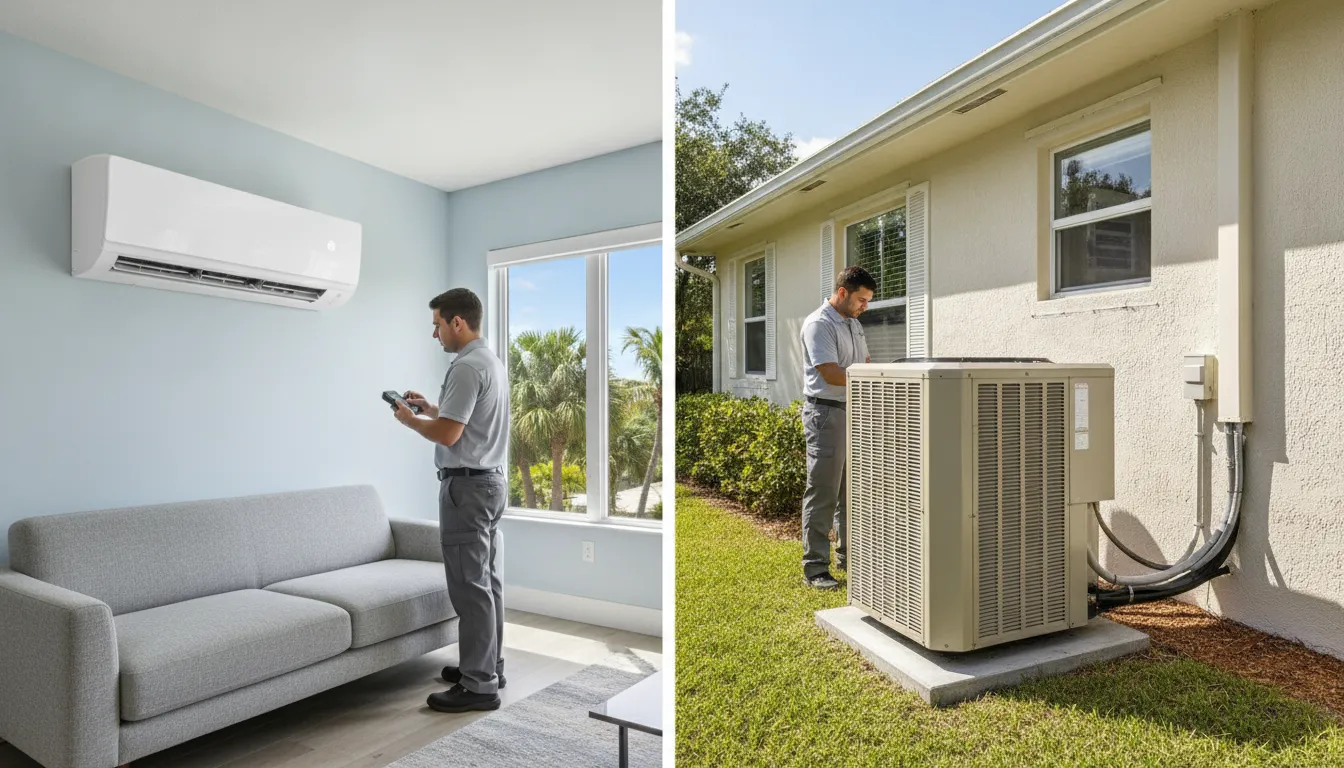
Florida homeowners rarely get to ignore their air-conditioning system. Heat, humidity, salt air, and long cooling seasons make efficiency and dependable comfort practical concerns, not just equipment preferences. The best system depends on your home's layout, existing ductwork, comfort goals, and how much control you want over individual rooms.
For ductless vs central AC Florida decisions, ductless mini-splits often make sense when you need room-by-room zoning. Are adding onto an older home, or want to avoid duct losses. Central AC may be the simpler fit when a sound duct system already serves the entire house. The U.S. Department of Energy notes that ductwork can account for more than 30% of air-conditioning energy consumption. So installation quality and system design matter as much as the equipment choice.
Before comparing efficiency, installation, and long-term cost, it helps to understand how each system delivers cooling.
How Ductless Mini Split Systems Work
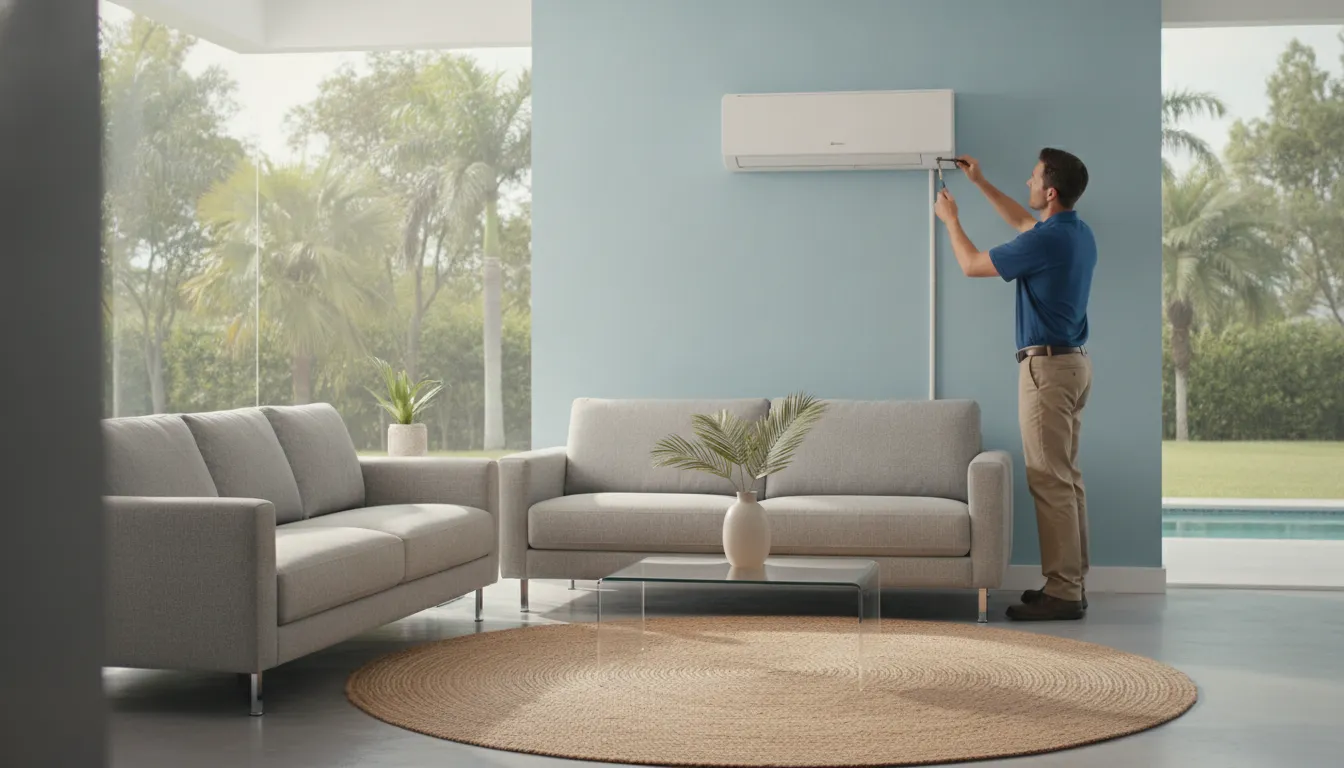
A ductless mini split uses an outdoor condenser connected to one or more indoor air handlers. Refrigerant lines, electrical wiring, and a condensate drain pass through a small opening in the exterior wall. The installation typically requires only a 3-inch hole for those connections. Which can make the system a practical option for older Florida homes, additions, garages, and renovations where installing new ductwork would be disruptive. Ductless mini split installation should still include careful sizing and placement of each air handler.
Inverter technology adjusts to the room
Many ductless systems use inverter technology to vary the compressor's output continuously. Instead of turning fully on and off whenever the thermostat calls for cooling, the system can increase or reduce capacity as the room's needs change. That approach supports steadier temperatures and can reduce the abrupt cycling associated with conventional equipment. Proper sizing remains important. The U.S. Department of Energy notes that oversized or poorly placed air handlers can short-cycle, waste energy, and provide inadequate temperature or humidity control.
One system can create multiple comfort zones
A single outdoor condenser can serve multiple indoor air handlers, allowing each connected room or zone to be controlled separately. A bedroom can be kept comfortable overnight without cooling an unused guest room. While a sunroom or converted garage can receive conditioning without extending a full central duct network. This room-by-room control is especially useful in Southwest Florida homes with varying sun exposure, additions, and spaces that are occupied on different schedules.
No ductwork means fewer distribution losses
Because the system delivers conditioned air directly from the indoor air handler, it avoids the energy losses associated with central forced-air ductwork. The Department of Energy reports that duct losses can account for more than 30% of air-conditioning energy consumption. Eliminating that distribution path does not guarantee a specific savings amount, since results depend on equipment efficiency, insulation, settings, and installation quality. It does remove one common source of loss, which matters in Florida, where air conditioning runs through long, hot, humid seasons.
How Central Air Conditioning Works
A central air conditioning system cools the home from one outdoor condenser and an indoor air handler or furnace cabinet. Refrigerant absorbs heat from indoor air, the system removes that heat outside, and a blower sends the cooled air through supply ducts. Return ducts carry warmer air back to the equipment so the cycle can continue.
The role of ductwork
Ductwork is the distribution network inside the walls, ceilings, attic, or crawl space. When it is properly sized, sealed, and insulated, it can deliver consistent cooling throughout a home without visible indoor wall units. That makes central AC a practical fit for homeowners who already have usable ducts and want one system to serve the entire house.
Ducts also introduce a potential efficiency loss. Even well-installed duct systems can lose 20% to 30% of conditioned air through gaps, loose connections, and heat transfer, according to the cited comparison source. Leaks or poorly insulated sections can make some rooms feel warmer while the system runs longer. In Southwest Florida, where air conditioning operates for much of the year, those losses can affect comfort and operating costs.
What changes in a home without ducts?
Installing central AC in a home that does not already have ductwork requires more than placing the equipment. Technicians must plan pathways, create supply and return runs, and account for access, insulation, and air sealing. Adding ductwork can cost an additional $1,000 to $5,000, depending on the home's layout and the complexity of the retrofit. That added work should be included in a complete estimate before comparing central AC with ductless options.
Central systems commonly achieve SEER ratings of 14 to 16. For help evaluating equipment, duct condition, and installation requirements, explore our central AC services.
Ductless vs Central AC: What's the Difference in Efficiency and Cost?
For Florida homeowners, the right comparison is not just the installation invoice. Equipment efficiency, ductwork, and how often the system runs all affect the total cost of ownership. The figures below provide a practical starting point, but final pricing and savings depend on the home's size, insulation, layout, and system design.
| Factor | Ductless mini split | Central AC |
|---|---|---|
| Typical SEER rating | 18 to 24 SEER | 14 to 16 SEER |
| Installation cost | About 30% higher upfront | Typically lower when suitable ductwork already exists |
| Potential energy savings | Up to 30% lower energy bills | Depends on equipment condition, ductwork, and usage |
| Duct loss | None from forced-air ductwork | About 20% to 30% of conditioned air can be lost through duct leakage and heat transfer |
| Ductwork cost when retrofitting | $0 for new duct installation | About $1,000 to $5,000 extra when ducts must be added |
Mini splits commonly carry higher SEER ratings than standard central systems. The comparison source lists 18 to 24 SEER for mini splits and 14 to 16 SEER for central AC systems. A ductless design also avoids the energy losses associated with central forced-air ductwork, which the U.S. Department of Energy says can account for more than 30% of air-conditioning energy consumption. Central systems can lose 20% to 30% of conditioned air through gaps, loose connections, and heat transfer, even when the ducts are well installed.
That difference matters more in Florida than in a mild-climate market. Many Florida homes run air conditioning for nine or more months each year, so a modest efficiency gap repeats across a long cooling season. A ductless system may cost about 30% more to install, but reported energy savings can reach up to 30%. If a central system needs new ductwork, the retrofit can add another $1,000 to $5,000. Review the design differences in our guide to ducted mini split vs central air before comparing quotes, and evaluate both the upfront price and the expected operating cost.
Why Your Ductless vs Central AC Florida Decision Depends on Climate
When comparing ductless vs central AC Florida homeowners need to account for more than equipment ratings. Heat, humidity, salt air, and a long cooling season all affect comfort, operating cost, maintenance, and the useful life of an air conditioner.
Humidity and duct leakage matter for more of the year
Many Florida households run air conditioning for nine months or longer. That makes every weakness in a central system more expensive over time. Ductwork that passes through an attic, garage, or other unconditioned area can lose conditioned air before it reaches the rooms. Even well-installed duct systems may leak 20% to 30% of conditioned air through gaps, loose connections, and heat transfer, according to industry comparison data (source on duct leakage and system comparisons).
A ductless system avoids that central duct loss and can cool only the rooms being used. Zone control is particularly useful when bedrooms, guest spaces, or additions have different schedules. The U.S. Department of Energy notes that mini-splits allow homeowners to cool individual rooms rather than conditioning the entire home (U.S. Department of Energy guidance). Proper sizing and placement still matter, especially for humidity control. An oversized or poorly located indoor unit can short cycle and leave a room feeling damp.
Salt air and storms increase equipment stress
Coastal communities such as Cape Coral, Fort Myers, Naples, Sanibel, and the Florida Keys expose outdoor equipment to salt-laden air. Salt can accelerate corrosion on coils, fasteners, and electrical components. Humidity, heavy rain, wind-blown debris, and hurricane-season wear add more stress to both central and ductless equipment. Maintenance, coil cleaning, and corrosion checks are not optional extras in this environment.
In harsh coastal conditions, equipment life can be shorter than the national average. With some systems lasting roughly 5 to 12 years depending on exposure, maintenance, installation quality, and usage. That range is a planning consideration, not a guarantee.
Older homes may favor a ductless retrofit
Older Southwest Florida homes, particularly in Cape Coral, Fort Myers, and Naples, may not have modern ductwork or enough space to add it economically. Ductless installation can provide room-by-room cooling without opening large sections of finished walls or ceilings. That flexibility can make it a practical retrofit when a homeowner wants reliable comfort without paying to build an entirely new air-distribution system.
When a Ductless Mini Split Makes Sense for Your Florida Home
Ductless cooling is often the practical choice when extending central air would require opening walls, adding supply runs, or building an entirely new duct network. That makes it especially useful for older homes in Cape Coral and historic areas of Fort Myers, where existing layouts may not have room for ductwork. Carrier notes that a ductless installation generally needs only a small opening for the refrigerant lines, which can reduce disruption during a renovation.
Older homes, additions, and converted spaces
A ductless mini split can serve a room that the existing system was never designed to cool. Common examples include a new bedroom, enclosed lanai, home office, or garage conversion. It can also provide dependable comfort in a home addition without requiring the original air handler to carry an oversized load or forcing contractors to route ducts through finished spaces.
This approach can help preserve the character of an older Southwest Florida home while limiting construction. Instead of estimating duct runs, soffits, and ceiling access, an HVAC professional can evaluate the room's insulation. Windows, solar exposure, and expected use, then select and place the indoor unit appropriately.
Zoned comfort for different households
Individual room control is another strong reason to consider ductless. The U.S. Department of Energy identifies zoning individual rooms as a key advantage of mini-splits. In a multi-generational home, one household may prefer a cooler bedroom while another spends most of its time in a living area. Separate indoor units let each zone receive cooling when it is occupied, rather than conditioning every room to the same setting.
Zoning also makes sense for guest rooms, lightly used areas, and spaces with different afternoon heat loads. Proper sizing and placement matter, especially in Florida's heat and humidity, so the system should be designed rather than selected from a room-size chart alone.
When avoiding duct costs matters
Retrofitting central AC with new ductwork can add substantial labor and construction. A ductless system may have higher upfront installation costs, but the potential energy savings can reach 30%, depending on the home, equipment, usage, and installation quality. The right comparison is the complete project cost, not just the equipment price.
As a Mitsubishi Diamond Contractor, 5 Star Air specializes in premium ductless installations throughout Southwest Florida. Review our ductless mini split installation options or explore our ductless mini split systems before deciding whether ductless or central AC is the better fit for your home.
When Central Air Conditioning Is the Better Choice
Central air conditioning is often the practical choice when your home is already designed for it. If the ductwork is properly sized, sealed, and in good condition, one central system can cool the entire house through an existing distribution network. That keeps the installation straightforward and avoids the visual presence of indoor wall-mounted air handlers.
Homes with existing ductwork
For a home with well-maintained ducts, central AC can be less expensive per unit of cooling than installing several ductless indoor units. The equipment and labor are not identical from one property to the next. But using an existing duct system can reduce the added work required for a multi-zone retrofit. A professional evaluation should still check duct condition, airflow, insulation, and past moisture concerns before replacement.
New construction and whole-home cooling
Central AC also makes sense in new construction where ductwork can be planned into the design from the beginning. This approach supports consistent, single-zone cooling throughout connected living areas and bedrooms. It is especially appealing to homeowners who want one thermostat and prefer not to see indoor equipment on their walls. Retrofitting ducts later can add meaningful expense. One industry comparison estimates that adding ductwork to a central system may add $1,000 to $5,000, depending on the project and home layout: see the source comparison.
Central AC is a strong fit when upfront equipment cost per ton is the primary concern. The home already has usable ducts, and whole-home single-zone cooling matches how the family uses the space. 5 Star Air installs premium Trane and Ruud central systems for Southwest Florida homeowners who need dependable whole-home cooling. Review our central AC services to see how an honest system evaluation can guide the choice.
Frequently Asked Questions
Is it cheaper to run a mini split or central AC in Florida?
Either system can be economical when it is correctly sized and maintained. A ductless system may use less electricity because it avoids ductwork losses, which the U.S. Department of Energy says can account for more than 30% of air-conditioning energy consumption. Central AC can remain cost-effective when a home already has well-designed, sealed ducts.
What is the best type of AC unit for Florida homes?
There is no single best system for every Florida home. Ductless cooling is often a strong fit for room-by-room zoning, older homes, additions, and properties without usable ducts. Central AC may be the better choice for whole-home cooling when existing ductwork is in good condition and the homeowner prefers one concealed system. A load calculation and duct inspection should guide the decision.
Does a ductless mini split help lower high electric bills?
It can, especially when unused rooms do not need to be cooled continuously. Zone control lets you direct cooling where it is needed, while inverter technology adjusts output instead of cycling only on and off. Savings depend on equipment efficiency, thermostat settings, insulation, humidity load, and installation quality. Avoid treating any projected savings as guaranteed.
How does Florida humidity affect ductless versus central AC?
Both systems must be sized and installed properly to manage Florida's heat and humidity. An oversized or poorly placed ductless air handler can short cycle, wasting energy and providing inadequate humidity control, according to the U.S. Department of Energy. Central systems also lose performance when ducts leak or pass through hot spaces. Ask the contractor how sizing, drainage, airflow, and humidity control will be addressed.
Ready to Compare Your AC Options?
The right system depends on your home's layout, existing ductwork, comfort goals, and how you use each space. A professional consultation can help you compare ductless and central air conditioning with practical recommendations for your Florida home. Schedule a free consultation with 5 Star Air to discuss your options and get clear guidance. Contact 5 Star Air online or call (239) 282-2222 to get started.